Skip to content
The Anatomy of the "Viking" Bearded Axe: Tool of the Hearth & Weapon of the Sagas
- by Daniel Farrand

In modern cinema and television, "Viking" axes are almost universally depicted as massive, unwieldy, double-bitted battle-axes designed exclusively for destruction. Yet when we examine the archaeological record - from 10th-century finds in Gotland to riverbed excavations across Yorkshire and the Danelaw - the historical reality is far more refined, versatile, and deeply human.
The defining cutting tool of the Viking Age was not a fantasy warhammer; it was the Skeggøx (literally "bearded axe"). It served as the primary tool of the hearth, the shipyard, and the forest long before it was ever carried into "shield wall" skirmishes or battles.
ARCHAEOLOGICAL PERSPECTIVE
"An axe in the Viking Age was a prized heirloom. It felled timber for longhouses, shaped ship strakes with surgical precision, gathered firewood through brutal winters, and defended the home when called upon."
The Mechanical Genius of the "Beard"
The term "bearded" comes from the Old Norse skegg, referring to the lower elongated hook of the axe head that extends downward well below the eye of the haft. While romanticized combat manuals focus on hooking enemy shields, the true genius of the beard lies in metallurgical (the science, study of metals and their alloys) efficiency and woodworking ergonomics.
For a deeper breakdown of Viking Age weaponry and historical tool development, explore our archive on the Nordic Mythology Podcast
- Choking Up for Fine Woodwork: By dropping the blade below the axe eye, a woodworker could slide their hand directly behind the cutting edge. This effectively converted an 800-gram chopping axe into an agile draw-knife or hand-plane for shaping tent poles, carving kindling, and truing planks.
- Maximum Edge, Minimal Deadweight: Iron was precious and labor-intensive to extract. Forging a deep beard yielded a generous 12–15 cm cutting face without adding unnecessary deadweight to the head.
- Fatigue-Free Balance: A lighter head positioned close to the center of rotation meant a woodsman could limb trees and process timber all day without blowing out his wrists or forearms.
From Bog Iron to High-Carbon Steel
Nordic smiths primarily smelted rauði (bog iron ore) gathered from peat bogs. Because high-carbon steel was extremely rare, original smiths forged the main axe body out of softer, shock-absorbing wrought iron, then forge-welded a thin sliver of hard high-carbon steel directly into the cutting edge.
At The Master Forge, we maintain these exact historical blade geometries while utilizing modern high-carbon tool steel. Each axe head is precision-forged, heat-treated, and tempered to ensure exceptional edge retention that holds up against hard timber, bushcraft chores, and camp life.
FEATURED FROM THE MASTER FORGE

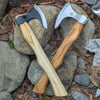
Ragnarok Skeggox
Extended beard profile • Contoured multi-grip ash haft • High-carbon steel head
£69.00
EXPLORE SKEGGOX →
Viking Throwing Axe
Historical Petersen Type M • Hand-carved Rosewood haft • Push-button leather sheath
£55.00
EXPLORE THROWING AXE →Ash Hafts and Traditional Wood Finishing
An axe head is only as dependable as the timber anchoring it. Historically, English Ash (Fraxinus excelsior) and dense rosewoods were selected across Northern Europe for their straight grain structure, high tensile flexibility, and natural shock absorption.
Every axe in our workshop is fitted onto a hand-shaped hardwood handle, wedged mechanically into the eye, and sealed with our signature blend of raw linseed oil and natural beeswax to protect the wood from moisture without making the grip slick during outdoor use.
18+ Only. In compliance with UK law, all axes and bladed articles are dispatched via an age-verified courier service. Valid photo ID and an adult signature are required upon delivery.
- Posted in:
- Living History
- Skeggox
- The Master Forge
- Viking Axe